
Sales Tax Bookkeeping in Texas: The Records Retailers and Service Businesses Cannot Ignore
Bookkeeping services in Texas can help keep a business from suffering a costly sales tax audit surprise.
Even though the Comptroller’s office has been known to err on the side of generosity, Texas retailers, service providers, and online sellers all create paper trails of invoices, exemption certificates, and receipts.
Gaps in these paper trails do not get the benefit of the doubt when it comes to sales tax.
Texas Sales Tax Audits Are Rising — Are Your Records Audit-Ready?
Retailers and service businesses face growing scrutiny. Learn exactly which records you must keep to survive a Texas sales tax audit without penalties.
Why Sales Tax Records Matter More Than Owners Realize
So many small business owners think that they can just file their sales tax return on time. This is, in fact, the return that is summarized; the documents are what the state actually looks at when a problem arises.
Any breaks in that history can result in an estimate of liabilities that may be greater than the actual numbers would have been. That’s why Texas bookkeeper services are a speciality that is not a general add-on to the accounting business.
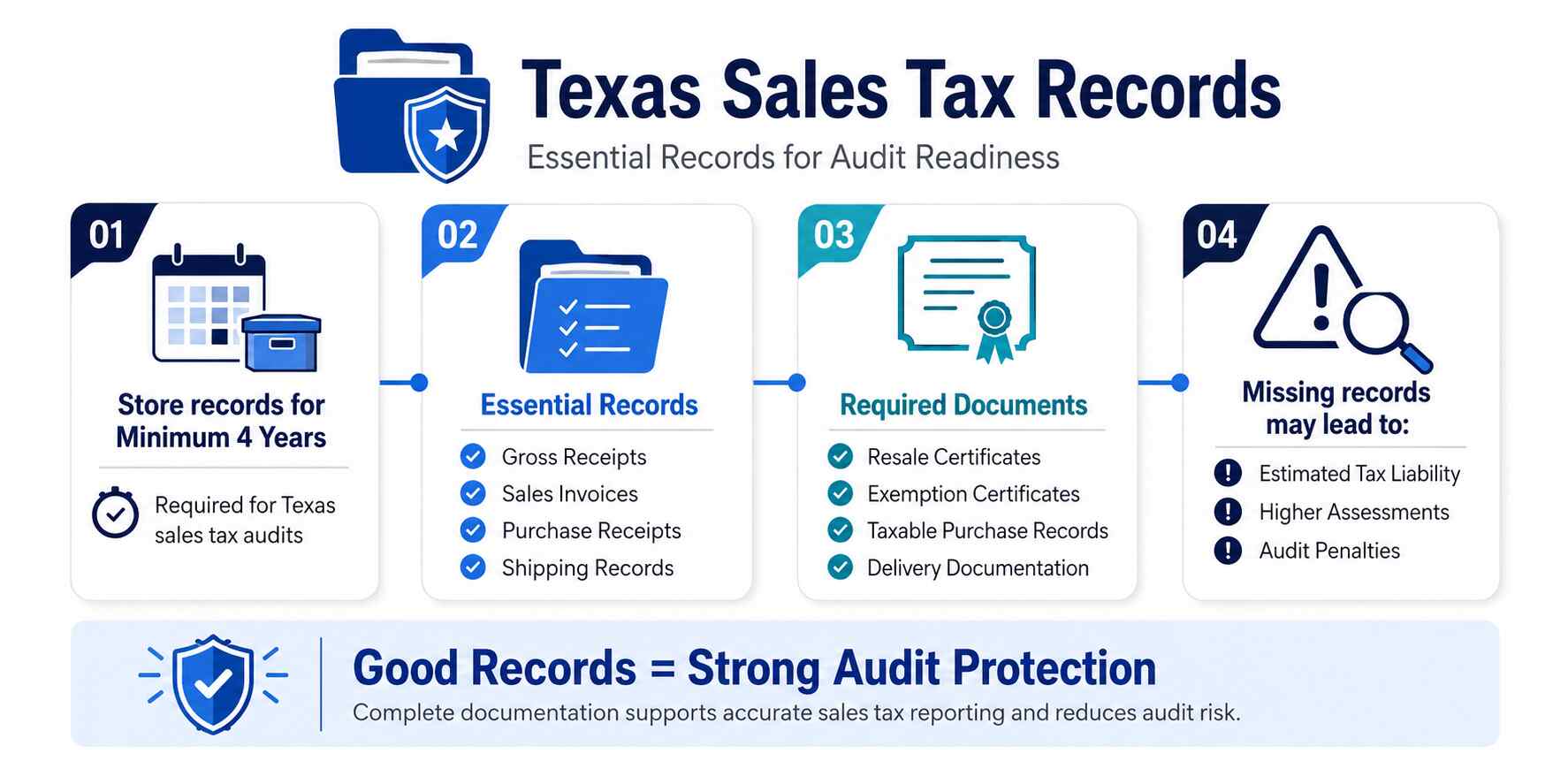
Businesses are required to keep sales and use tax records for a minimum of four years, unless the Texas Comptroller’s official guidance provides written permission to destroy them earlier. Failure to produce records during an audit may result in an estimated assessment.
What Records Retailers Need to Keep
Service businesses have a different type of documentation requirement from retailers as they do not have inventory, shipping, and resale exemptions.
What should be on file at all times:
- Gross receipts records, such as tapes and invoices
- Buy receipts for goods sold for resale (which are taxable).
- The exemption and resale certificates are issued by wholesale buyers.
- Shipping and delivery documentation, as taxability may hinge on shipping methods.
Taxable and non-taxable labor must be monitored closely for service businesses.
Whatever it may be, from a boutique to a repair shop or an agency that provides bookkeeping packages for agencies, the bottom line is that without it on paper, it cannot be justified in the event of an audit.
Bookkeeping for Different Business Models
Texas business models vary, and sales tax requirements change from one model to another. The recordkeeping needs differ among agencies, brokers, and multi-location retailers.
It’s common for bookkeeping services for brokers to split commission income between taxable and non-taxable components, since not all expense categories are reimbursed.
One of the common bookkeeping services for agencies is pass-through billing of clients and accurate labelling of taxable and non-taxable charges.
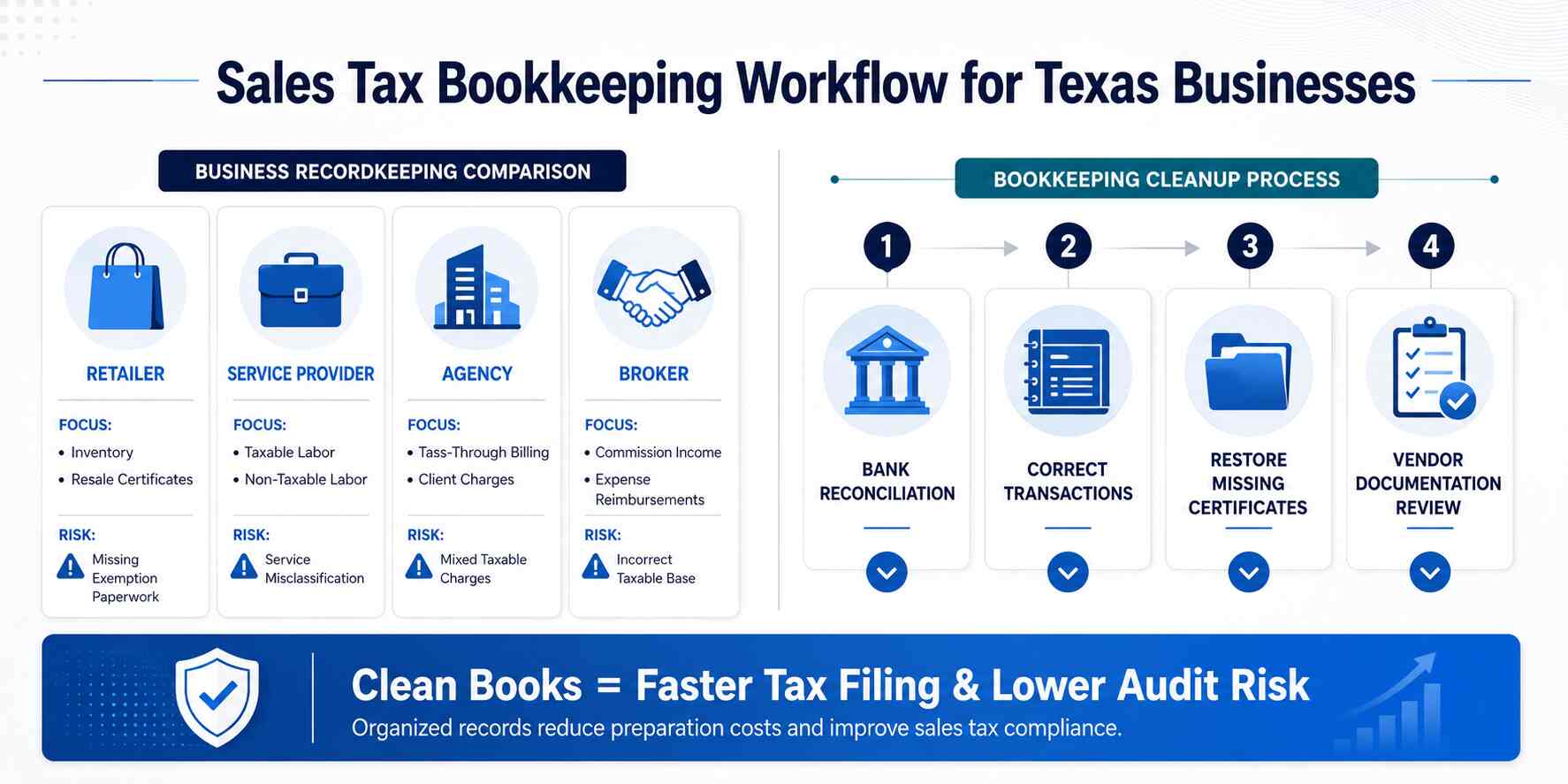
| Business Type | Main Recordkeeping Focus | Common Risk Area |
| Retailer | Inventory purchases, resale certificates | Missing exemption paperwork |
| Service Provider | Taxable vs. non-taxable labor | Misclassified services |
| Agency | Pass-through client billing | Blended taxable/non-taxable charges |
| Broker | Commission vs. reimbursed expense | Incorrect taxable base |
These holes need to be addressed, and most companies will require a program to be followed before filing time.
- Comparing bank account statements with sales records
- Reclassifying miscategorized transactions
- Rebuilding missing exemption certificate files
- Flagging recurring vendors with incomplete documentation
Cleanup Work and preparing for the filing season.
Businesses that continue to let receipts remain unorganized will eventually need a catch-up project before filing with confidence again.
It’s the time of year when bookkeeping cleanup NYC firms, as well as those in Texas, see an increase in demand each year at the time of the tax season bookkeeping crunch, and it generates clean books for taxes that pass muster.
Missing Sales Tax Records Cost Texas Businesses Thousands — Don’t Be Next
Exemptions, resale certificates, and transaction logs — discover the critical records every Texas retailer and service provider must maintain.
What Drives Bookkeeping and Tax Prep Costs
Owners frequently think of cost as their first question, and it depends on the size of the business, transaction volume, and the degree of messiness of the starting point. The months to be reconciled and the number of exemption certificates to be looked up are some of the bookkeeping cleanup cost factors.
When books are inaccurate, the cost of tax preparation for a small business can skyrocket because the preparer must correct errors before preparing the return.
When owners ask, “How much does bookkeeping cost in LA versus how much does bookkeeping cost in New York?” the cost is more likely to correspond to the cost of living in the area than to the difficulty of the task.
Choosing the Right Approach
Some owners handle their own record-keeping early on, but the more records they keep, the more likely the paperwork will be lost. The decision between outsourcing bookkeeping and hiring an in-house bookkeeper for NYC businesses is ultimately about time vs. risk tolerance when considering DIY bookkeeping vs outsourced bookkeeping.
That goes a long way to explaining why bookkeeping outsourcing firms in the USA, such as The Accounting Express, Los Angeles Bookkeeping Services, and San Francisco outsourced bookkeeping services, have been steadily expanding.
The IRS’s recordkeeping requirements state that organized records support all items on a tax return; this consistency is the first step toward avoiding the seven bookkeeping mistakes small business owners make.
Conclusion
In Texas, sales tax compliance is not about filing tax forms on time; it is about filing them correctly and keeping them on file to withstand an audit.
It’s either long-term bookkeeper services in Texas or a cleanout, then compare pricing for bookkeeping services in New York, but it’s all about records that tell a clear and defensible story.
What Texas Retailers Must Track for Sales Tax — Or Face the Consequences
One missing exemption certificate can derail your entire audit. Get the complete checklist of records you cannot afford to ignore in the Lone Star State.

- All Posts
- Accounting And Finance
- All Blogs