
5 Payroll Mistakes That Can Trigger IRS Penalties (and How to Avoid Them)
In the world of business, there are dozens of moving parts, and payroll can have a significant impact. Penalties for missed deposits, misclassified employees, and incorrect filings can accumulate quickly and sometimes reach thousands of dollars due to a single mistake by the IRS.
That is why many companies that are growing are looking for payroll management services that will ensure that their payroll is accurate and on time. Employers have specific deadlines to report and withhold wages, tips, and withheld taxes, and the IRS will be on their radar if those deadlines are not met, according to the IRS itself, in its Payroll Professionals Tax Center.
Payroll Mistakes Are Costing You Thousands — Are You Making These 5 Errors?
Late deposits, misclassified workers, incorrect filings — the IRS doesn’t forgive. Learn how to avoid these costly mistakes and keep your business safe.
What Is Payroll Management and How Does It Work?
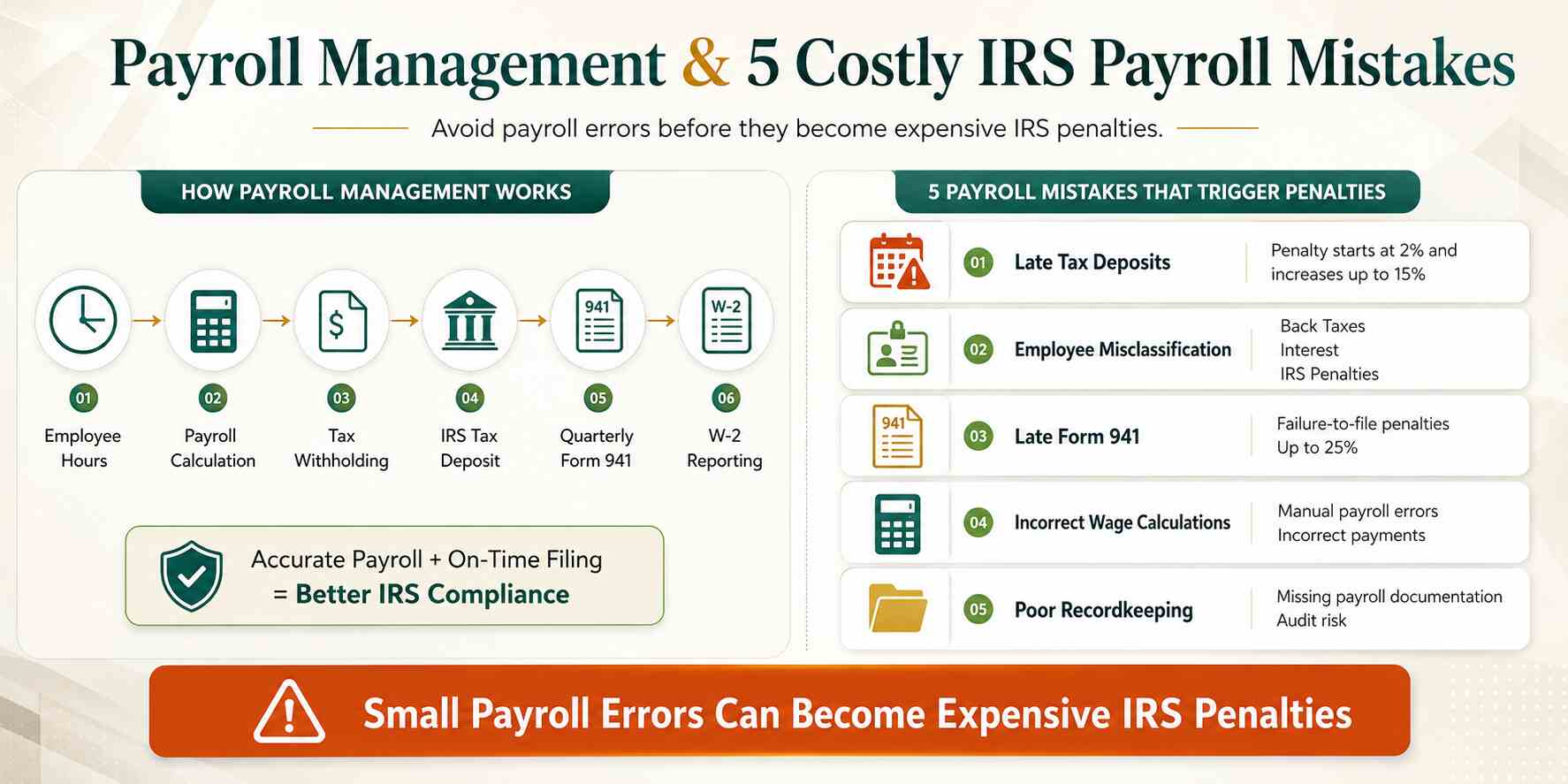
What is Payroll Management and How Does it Work? Payroll management is essentially about calculating payroll, withholding federal and state taxes, paying them to the IRS on a specific schedule, and filing quarterly returns and year-end forms, such as W-2s.
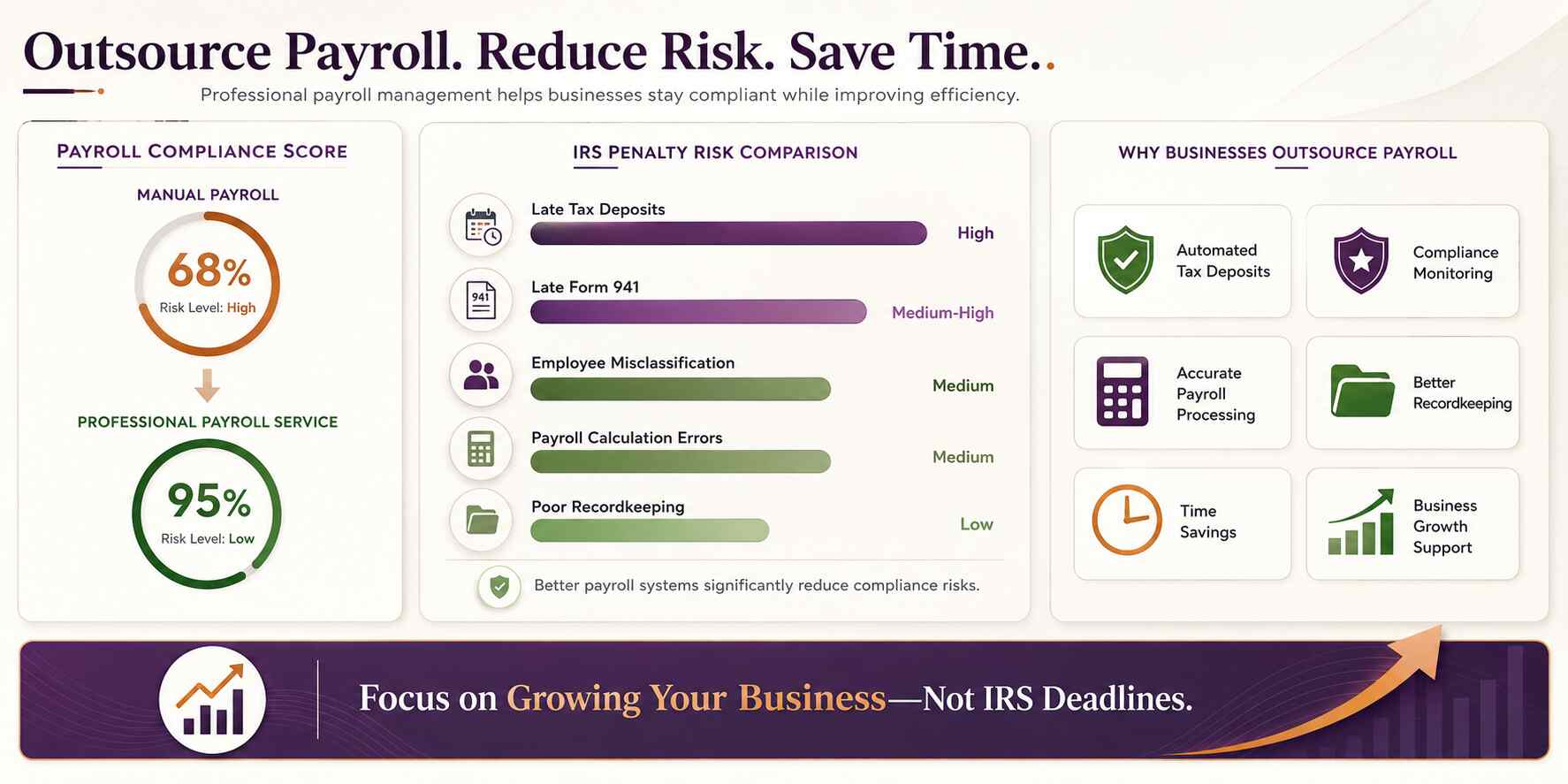
Payroll can be handled by a business manually, using software, or by outsourcing to a payroll service provider. Manual methods introduce additional opportunities for human error, whereas professional payroll management services incorporate compliance monitoring directly into the procedure, lowering the chances of failing to meet deadlines or making errors.
Common Payroll Mistakes and How to Avoid Them
Understanding where common payroll mistakes can occur is the first step in Common Payroll Mistakes and How to Avoid Them. The IRS applies penalties that increase with the delay in a deposit, and a late deposit of just a few days can equal real money for a business. Here are the five most common penalties that cause penalties:
- Missing deposit deadlines: late deposits incur a penalty starting at 2%, rising to 15% the longer they go unpaid.
- Misclassifying employees as contractors: triggers back taxes, interest, and penalties once corrected.
- Filing Form 941 late: failure-to-file penalties accrue at 5% per month, up to 25% of the unpaid tax.
- Inaccurate wage calculations: manual data-entry errors can lead to underpayment penalties.
- Poor recordkeeping: missing documentation makes it harder to dispute a penalty later.
Don’t Let Payroll Mistakes Trigger an IRS Nightmare — Fix Them Now
One wrong calculation can lead to penalties and audits. Discover the 5 most common payroll errors and exactly how to prevent them in your business.
How Much Do Payroll Services Cost for Small Businesses?
Owners frequently have a hard time deciding whether to outsource payroll or handle it in-house because of the cost of payroll services for small businesses. The fees are usually based on the range of services provided, whether it’s just filing taxes or comprehensive HR services, the frequency of payments, and the company size.
The fee seems like another expense, but it is typically not as high as the cost of an IRS penalty, so many small teams consider it a good investment rather than a luxury.
| Service Level | Typical Monthly Cost | What’s Included |
| Basic | $40–$80 + per employee fee | Tax deposits, direct deposit |
| Standard | $80–$150 + per employee fee | Filings, W-2s, compliance alerts |
| Full-Service | $150+ | HR support, benefits admin |
7 Benefits of Outsourcing Payroll Services
Outsourcing your payroll services offers more than just a way to avoid penalties; it introduces structure and accountability into an area that’s simple to neglect during hectic weeks:
- Automated, on-time tax deposits
- Minimize misclassification errors.
- Compliance experts are available to assist.
- Time saved on administrative tasks
- Produce record-keeping and audits
- Easier year-end tax form processing
- As team size increases, scalability to support growth.
How To Run Payroll For a Small Business: A Beginner’s Guide
How To Run Payroll For a Small Business: A Beginner’s Guide will guide you step-by-step from the basics to more complex processes. New employers must have an Employer Identification Number, a clear payroll plan, and tracking of hours and withholdings from the start.
After that, it’s a cycle of calculations, deductions, deposits, and quarterly and annual forms. It’s a much more relaxed cycle for businesses that work with companies such as The Accounting Express because they know what to expect and can manage all deadlines and documentation.
According to one such report on payroll penalty trends, almost 40% of all small businesses end up paying a penalty due to this payroll error in a particular year, revealing the level of payroll errors and how avoidable they are. (Gloucester City News)
Conclusion
While it might not be the most thrilling aspect of running a business, payroll compliance is one of the most expensive things to get wrong. Little mistakes can add up to huge IRS penalties over the years, from failing to deposit a payroll check to incorrectly categorizing employees.
Working with trusted payroll management services allows business owners to avoid missing payroll deadlines, minimize risks, and invest more time in growing their company rather than dealing with paperwork.
The IRS Is Watching — Are Your Payroll Records Audit-Ready?
Employee classifications, tax deposits, and filing deadlines — we’ll help you fix the 5 mistakes that trigger IRS penalties and give you peace of mind.

- All Posts
- Accounting And Finance
- All Blogs