
John Flores
Content Marketing Enthusiast
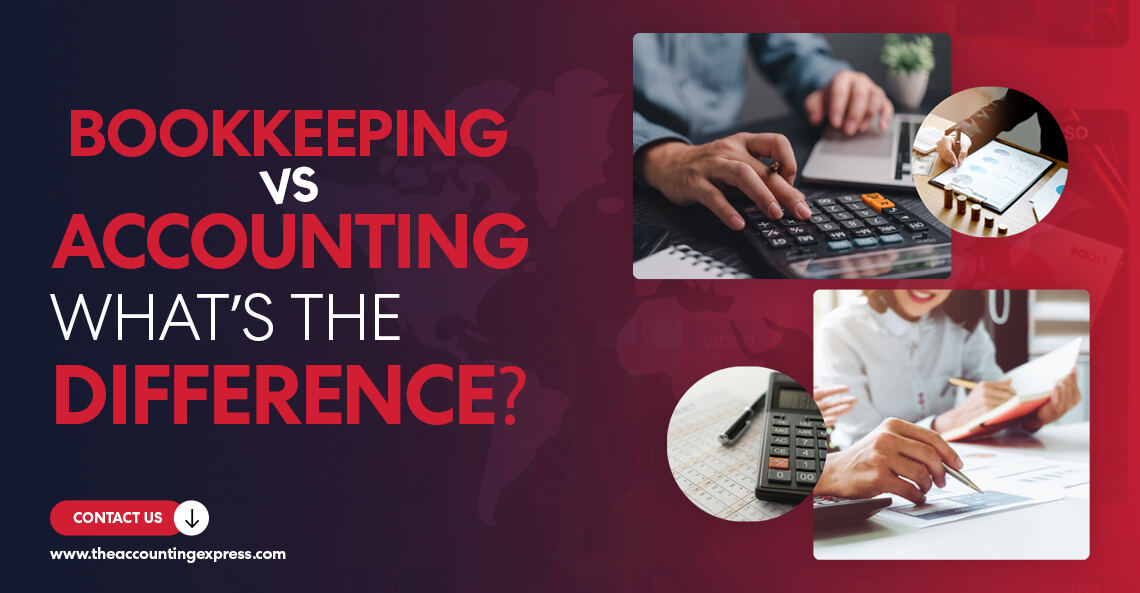
Bookkeeping vs Accounting: What’s the Difference?
It is a very common misassumption among the majority of small business owners to consider bookkeeping and accounting as the same concepts – cash comes in, expenses go out, taxes get filed, and everything looks in place. But reality is different. It often hits suddenly: during tax season, when cash flow issues surface, or lender reviews fail to explain financial performance.
Businesses aiming to improve clarity or outsource bookkeeping services need to understand this difference thoroughly, as it can help prevent costly mistakes and support smarter financial decisions in the long run.
More Time. Less Stress. Cleaner Books.
You run your business. We’ll handle the numbers. From daily transactions to tax season — The Accounting Express keeps you compliant and profitable.
Bookkeeping Records the Numbers; Accounting Explains the Story
At its core, bookkeeping statistically records financial operations in a business, including sales, payroll, invoices, expenses, subscriptions, refunds, and vendor payments. Whereas accounting starts where bookkeeping ends – it’s a relay race between the two.
Accounting takes these numbers and turns them into insights through profit analysis, risk identification, optimized tax plans, and opportunities for better decision-making for small businesses.
On paper, the boundaries are easy to draw, but on the ground, the boundaries get blurred and lead to confusion. Both functions usually overlap, use the same software, and may even be managed by the same person in smaller companies.
Let’s not forget that the objective remains different. A bookkeeper would record a $400 marketing expense; an accountant would find out whether the $400 was converted into actual profit. A bookkeeper logs payroll; an accountant evaluates labor costs and staffing efficiency.
A bookkeeper’s primary focus is to ensure accuracy. Accountants have to apply judgment – particularly during audits, tax planning, funding requests, or financial slowdowns. According to Forbes Advisor, poor recordkeeping remains a big cause behind the financial struggles of small businesses.
Bookkeeping vs Accounting: Impact on Business Outcomes
As both deal with numbers, they are often mistaken for interchangeable. From a practical perspective, one establishes financial order while the other sets the financial direction.
Understanding these differences helps businesses avoid blind spots, specifically when exploring bookkeeping services such as online bookkeeping services, or deciding whether to outsource bookkeeping services to achieve sustainable, enduring efficiency.
Stop Guessing. Start Growing With The Accounting Express.
Whether you need bookkeeping, tax preparation, or financial consulting — we’ve got you covered. Accurate, affordable, and built for businesses like yours.
Purpose: Recording vs Decision-Making
Bookkeeping emphasizes accuracy. Each invoice, payroll entry, payment, and expense gets recorded properly. Accounting takes those records and evaluates what they really mean for profitability, tax efficiency, and growth. For example, a bookkeeper may record a decrease in monthly sales, while an accountant spots the pricing issue behind it and suggests corrective measures.
Scope: Transactions vs Financial Strategy
Bookkeeping deals with day-to-day financial transactions. Accounting operates at a broader level, encompassing forecasting, budgeting, and tax planning. A startup tracking expenses may rely on bookkeepers at first, but expansion usually requires accountants to support hiring, pricing, and investment-related decisions.
Output: Data vs Financial Visibility
Bookkeepers generate ledgers and reconciled records. Accountants conduct analyses and produce financial reports for lenders, investors, and tax authorities. As a result, most businesses evaluating Bookkeeping Cost for Small Businesses integrate bookkeeping with professional financial oversight.
Compliance: Accuracy vs Audit Readiness
Clean books minimize errors, but accounting enhances compliance and solidifies audit preparedness. Firms like The Accounting Express, at this point, become valuable by integrating reporting, tax readiness, and structured execution into a single dependable system.
Finally, bookkeeping keeps a track of the journey; accounting explains where the business is actually heading.
Your Financial Success Starts With The Right Partner.
The Accounting Express provides expert accounting services tailored to your unique needs. No surprises. No hidden fees. Just clarity and confidence.
How Financial Systems Actually Work?
Financial systems may look simple on the surface, but smart + strong systems would follow a structured monthly rhythm:
Step 1: Recording Transactions – Bookkeepers’ Job
Bookkeepers record invoices, payroll, subscriptions, expenses, and payments. Platforms like QuickBooks, Xero, and Zoho Books automate tracking and enhance bookkeeping services accuracy.
Step 2: Reconciliation of Accounts – Bookkeepers’ Job
Bookkeepers match bank records, payroll, and transactions to spot duplicates, missing entries, or reporting gaps before they turn into irreversibly expensive.
Step 3: Developing Financial Reports – Bookkeepers + Accountants Job
Profit and loss statements, balance sheets, and cash flow reports convert raw numbers into visibility, enabling businesses to function beyond guesswork.
Step 4: Statistical Analysis – Accountants’ Job
At this stage, Accountants take the lead and assess profitability, spending patterns, risks, forecasting, and tax efficiency.
Step 5: Compliance & Audit Readiness – Bookkeeping + Accountants’ Job
A good bookkeeper’s job is to ensure compliance, whereas good accounting would improve audit readiness.
The trend is moving towards integrating Accounting services for businesses: reporting and compliance for better financial management.
At this point, firms like The Accounting Express usually prove their relevance – not just for data entry, but as an execution layer that avoids financial friction before it gets costly.
Let’s Talk Numbers.
Whether you’re a startup or an established brand — The Accounting Express helps you save more, stress less, and sleep better.
How AI and Industry Shifts Are Redefining Financial Operations in 2026
The future of bookkeeping and accounting is evolving and fast becoming automated – but not completely automated yet. Across industries and sectors, including retail, healthcare, startups, and service businesses, AI now enables expense categorization, spotting unusual transactions, automating reconciliations, and enhancing forecasting accuracy.
Platforms like QuickBooks, Xero, and Zoho Books are redefining bookkeeping services for small business operations. According to the AI trends in accounting for 2026, automation minimizes manual workload, but human judgment remains relevant for tax planning, audits, and compliance.
This is particularly significant for bookkeeping services for startup companies, where fast growth usually outpaces financial systems. Now, businesses are leaning toward outsourced bookkeeping services that combine automation with professional oversight rather than relying solely on software.
High-Cost Small Business Mistakes
Small businesses do not fail due to a single accounting mistake; errors generally compound gradually into major collapses.
Common Mistakes Include
- Assuming bookkeeping and accounting are similar tasks.
- Deliberate delay in reconciliations.
- Overlooking and ignoring financial reports while making decisions.
- Complete reliance on spreadsheets.
- Preparing finances only during tax season.
The practical solutions are unexpectedly straightforward:
- Maintenance of monthly reviews.
- Organizing records regularly.
- Integration of bookkeeping with financial analysis.
Businesses adopting Accounting services for businesses alongside structured reporting usually prevent last-minute tax-related messes, missed deductions, and unnecessary compliance pressure before mistakes become irreversibly expensive.
Conclusion
Bookkeeping and accounting do appear similar on many fronts, but they address very distinct challenges. Bookkeeping maintains the structure and accuracy of financial records, while accounting translates those records into smarter, insight-driven decisions, stronger planning, and risk-prevention measures.
One records the stats; the other makes those stats meaningful. For businesses deciding whether to outsource bookkeeping services, firms like The Accounting Express demonstrate the significance and relevance of outsourcing by integrating bookkeeping, reporting, compliance, and long-term financial clarity into a single, reliable workflow.
Let’s Talk Numbers.
Whether you’re a startup or an established brand — The Accounting Express helps you save more, stress less, and sleep better.
FAQ'S
Bookkeeping keeps a record of numbers, whereas accounting converts these numbers into insights for financial reporting, forecasting, taxes, and compliance.
The four common types of bookkeeping are single-entry, double-entry, virtual bookkeeping, and outsourced bookkeeping, each suited to different business sizes and operational complexities.
None of them is better over each other. They serve different purposes and are highly significant and relevant in their respective domains.
Yes, this is a natural progression, as many bookkeepers pursue accounting certifications or degrees and ultimately shift into financial reporting, tax planning, and advisory roles.
Not completely. AI automates repetitive tasks, but human supervision still matters for judgment, compliance, problem-solving, and financial interpretation.

About The Author
A finance and accounting professional with a strong passion for helping businesses grow, John Smith specializes in delivering clear financial insights and strategic accounting solutions. With extensive experience in bookkeeping, tax planning, financial reporting, and business advisory, he is dedicated to simplifying complex financial processes and helping companies make smarter financial decisions with confidence.
Let's Discuss
Recent Blog
- All Posts
- Accounting And Finance
- All Blogs





Related Tags
- bookkeeping and tax services
- bookkeeping services
- CFO Accounting Services
- CFO Services
- Fractional CFO Services
- online accounting and bookkeeping services